
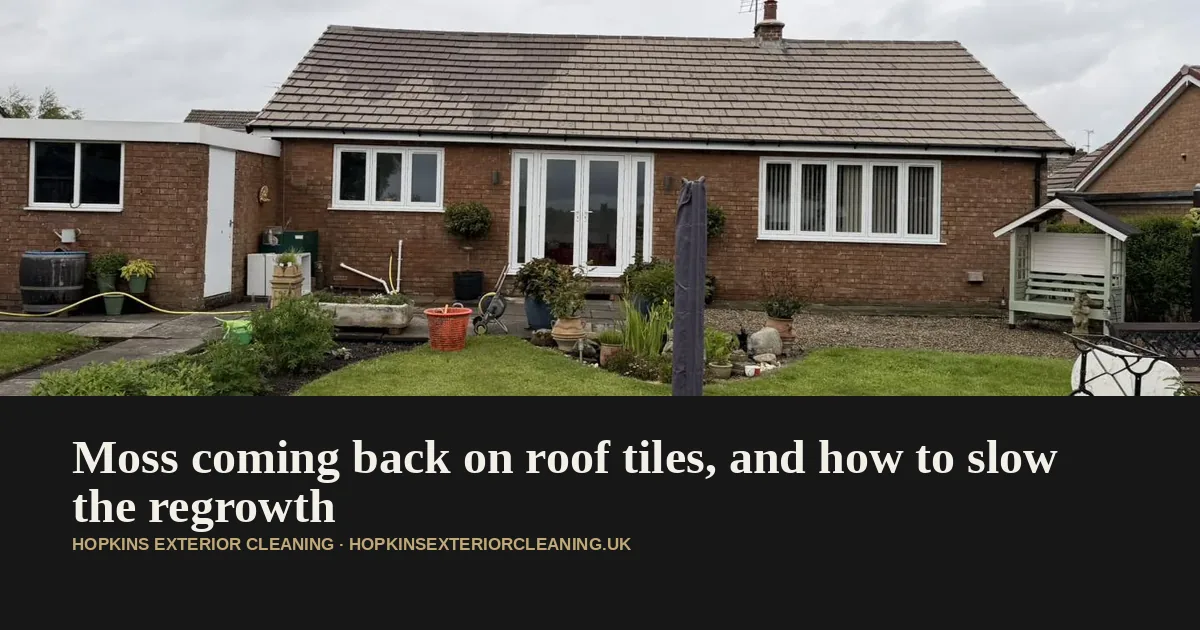
If your roof was cleaned two winters ago and there is already green along the bottom edge of the tiles, nothing has gone wrong. Moss coming back on roof tiles is normal. A roof is damp, shaded on at least one side, and covered in exactly the sort of rough surface that spores like to sit in.
The question worth asking is not whether it returns. It is how fast, and what was actually done to slow it down.
A moss removal job we did on a bungalow in Thirsk three years ago is still clear on the south pitch and has a light green haze on the north. That is roughly what good looks like.
Why moss coming back on roof tiles happens so fast
Moss does not really grow from the clump you can see. It grows from spores, and the spores are everywhere: in the air, in the gutter silt, in the tree canopy hanging over the boundary fence.
Scraping or jet washing takes off the visible growth and leaves those spores sitting in the pores of the tile. One season of decent Yorkshire rain and they are away again. That is why a DIY scrape looks brilliant in April and tired by the following spring.
There is a second problem with scraping. A stiff brush on a concrete tile takes the fired surface off along with the moss. The tile then holds water instead of shedding it, so the roof moss regrowth is faster than it was before anyone touched it.
What a biocide treatment actually changes
A proper soft wash is a low pressure biocide treatment, not a blast. The chemical kills the growth at root level and knocks back the spores sitting around it. The dead material then breaks down and washes off over the following weeks of rain.
The visible result is slower than a scrape. You do not get the dramatic before and after photo on the day the van leaves. What you get instead is a roof that stays clear for three to five years rather than one.
The difference is not the pressure. It is whether anything killed the spores.
The four things that decide how quickly it returns
Only one of them is the clean itself.
Shade. A roof under a sycamore greens up twice as fast as the same roof in open sun. Cutting back an overhanging branch buys you a year or two.
Gutters. Silt in the gutter is a seed bed. Keeping them clear keeps the bottom two courses of tile drier, which is where regrowth almost always starts.
Pitch and material. Shallow pitched concrete tiles hold water. Steep clay and Yorkshire stone shed it. You cannot change the roof, but it tells you what to expect.
Aspect. North facing pitches dry slowly and go first, every time. On most houses around Thirsk and Northallerton the north pitch needs looking at roughly twice as often as the south.
When it is worth booking another clean
A light green fuzz on the north pitch is not a job yet. We will tell you if it does not need doing, and we mean it, because a roof handled too often is a roof at more risk than one left alone for another season.
The trigger is clumps thick enough to hold water against the tile, or moss dropping into the gutters and blocking them. That usually lands three to five years after a proper soft wash, and about eighteen months after somebody has been up there with a scraper.
If you are not sure which stage you are at, a photo taken from the ground is usually enough for us to tell you over the phone. We cover Thirsk and the villages around it for free quotes, and the contact form is the quickest way to get eyes on it.
For the method side of things, and what not to do with a brush, our write up on moss removal in Helmsley covers the rest.